
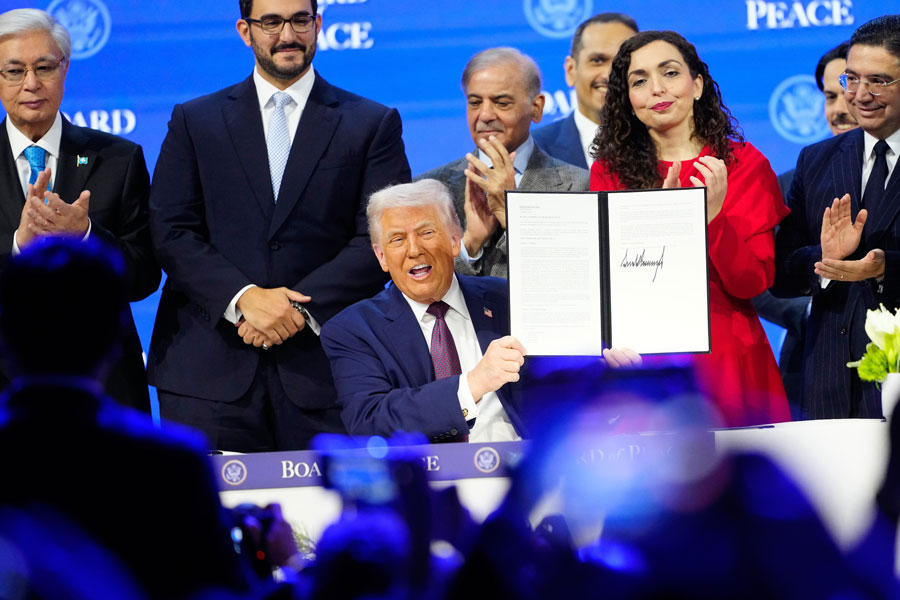
President Donald Trump launched his Board of Peace initiative at the World Economic Forum in Davos, Switzerland, aimed at maintaining a ceasefire in the Israel-Hamas war and mapping out a future for Gaza. Trump envisions the board as a global body that could eventually rival the United Nations. Ali Shaath, head of a planned technocratic government in Gaza, announced the Rafah border crossing would open in both directions, though Israel offered no immediate confirmation. Despite Trump's claim that 59 countries had signed on, only officials from 19 countries, plus the U.S., were present at the event.

Many key U.S. allies, including Britain, Norway, Sweden, France, Canada, Ukraine, China, and the European Union, have opted not to participate or have expressed reservations. Britain cited concerns about broader treaty issues and the potential involvement of Russian President Vladimir Putin, given the ongoing conflict in Ukraine. France also expressed concern that the board might seek to replace the UN. Russia stated it was still consulting with its "strategic partners" before committing. An Arab diplomat indicated that Middle Eastern governments coordinated their response, viewing the charter as potentially conflicting with the UN's mission.
Trump reiterated his demand for Hamas to disarm and warned of consequences if they refuse, while also stating the war in Gaza is "coming to an end." The initiative follows Trump's threats of military action against Iran, which he stated were critical to the Gaza ceasefire. Separately, Trump met with Ukrainian President Volodymyr Zelenskyy, and his envoys are slated for talks in Moscow regarding the Ukraine war. Zelenskyy announced upcoming trilateral meetings between the U.S., Ukraine, and Russia in the UAE.